About Services Technology Contact Start a project
Capabilities

Engineering, from the first sketch to steady state.

We don't sell a menu of services. We take responsibility for a system's whole life — the architecture that shapes it, the code that runs it, and the quiet discipline that keeps it healthy over time.

Scope a project with us
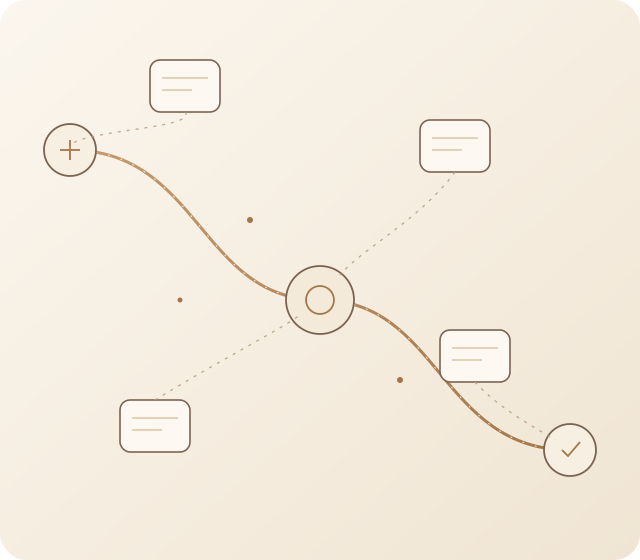
An engineering pipeline of connected nodes carrying work from concept through to delivery.
Where we go deep

Four disciplines, held together.

01

Platform & product engineering

SaaS products and business platforms built to carry real users and real change. We own the architecture, the delivery and the operational shape — so what launches is something you can grow, not something you have to escape.

Domain-driven design Multi-tenant SaaS Event-driven systems Performance engineering
02

APIs & system integration

The connective tissue of a modern business. We design interfaces that other teams can build on with confidence, and untangle the integrations that have quietly become a company's biggest risk.

REST & GraphQL Event streaming Legacy modernisation Partner integrations
03

Cloud architecture & operations

Foundations that stay calm under load and clear on cost. We design infrastructure you can reason about, automate the tedious parts, and give your team the visibility to run it with confidence.

Infrastructure as code Observability Cost engineering Resilience & recovery
04

Internal systems & transformation

The tools that run the business behind the scenes. We replace the spreadsheets, the manual handoffs and the ageing internal apps with software your teams are glad to open each morning.

Workflow automation Data platforms Internal tooling Process redesign
The engineering method

How a system takes shape.

A repeatable path from first conversation to a system that runs itself — deliberately paced, with a checkpoint you can act on at every turn.

Step 01

Discovery

We learn the business, the constraints and the people. The output is a shared, written understanding — not a stack of assumptions.

Step 02

Architecture

We shape the system on paper first — boundaries, data, interfaces — so the expensive decisions are argued before they're built.

Step 03

Build

Working software each week, tested as it's written and reviewed in the open — no big-bang reveal at the end.

Step 04

Release

We ship in controlled, reversible steps — behind flags where it helps — so going live is an ordinary Tuesday, not an event.

Step 05

Operate

We watch what we built in the real world, tune it against evidence, and make sure it behaves under conditions that don't read the plan.

Step 06

Hand over

Documentation, walkthroughs and a codebase your team can own. Our success is measured by how little you need us afterwards.
The architecture lifecycle

Decisions, in the order they matter.

Architecture isn't a document produced once. It's a sequence of choices, each one narrowing risk before the next begins.

First

Understand the load

What must this system do, how often, and what happens on its worst day? Everything downstream answers to this.

Then

Draw the boundaries

Where responsibilities begin and end — the seams that let a system grow without tearing.

Then

Model the data

The shape of the information a business actually holds. Get this right and the code follows quietly.

Finally

Choose the tools

Technology is the last decision, not the first — chosen to fit the problem we've now understood.

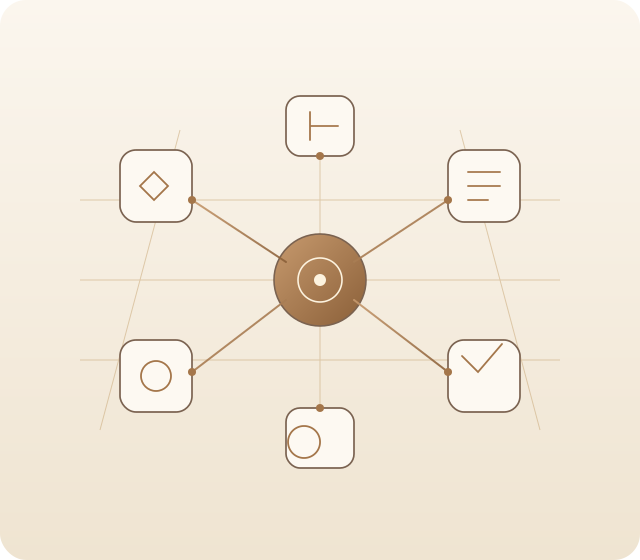
A structured lattice of connected modules around a central core.
Delivery methodology

Agile where it helps, rigour where it counts.

We take the useful half of agile — short cycles, constant feedback, working software — and pair it with the engineering rigour that stops a project drifting. Ceremony for its own sake, we leave behind.

  • Fixed rhythm of demos and decisions, so nothing hides for a fortnight.
  • A living backlog shaped by evidence, not by whoever spoke loudest.
  • Quality built in continuously — testing, review and automation as habits, not gates.
  • Clear definition of done, agreed before work starts.
Chosen with care

A toolkit we know to the ground.

We keep our stack intentionally small so we can master it. Here's a taste — the full picture lives on our technology page.

TypeScript Go Python PostgreSQL Kubernetes Terraform React Event streaming AWS & GCP
See the full toolkit
Why larger organisations choose us

Grown-up software, without the overhead.

Senior throughout

You get experienced engineers on the tools, not a junior team shadowed by a distant lead. The people who scope your work are the people who build it.

Answerable and insured

A UK-registered company with the contracts, cover and governance that procurement teams expect — and none of the theatre they dread.

Built to be handed over

Every engagement is designed to end well. You keep the code, the knowledge and the confidence to carry on independently.

Honest about risk

We surface the awkward truths early — the dependency nobody owns, the estimate that won't hold — while they're still cheap to address.

Fits your process

We work inside your controls, tools and compliance needs rather than around them, and leave an audit trail you can stand behind.

Measured, always

Performance, cost and reliability are tracked and shared. You never have to take our word for how the system is doing.

Questions, answered

The things clients ask first.

How do engagements usually begin?

With a conversation and a short discovery. Before we quote anything substantial, we want to understand the problem well enough to tell you honestly whether we're the right people — and what we'd tackle first. That discovery is a modest, fixed piece of work that stands on its own.

Do you work with our existing team?

Nearly always. We build with your people rather than in isolation, so knowledge transfers as we go and there's no cliff edge at handover. Some clients embed us alongside their engineers; others hand us a whole slice to own. Both work well.

How do you price and contract?

Most work runs on a time-and-materials basis with a clear cadence of review, which suits software that evolves. Where scope is genuinely fixed, we can price a defined phase. Either way you'll know what you're committing to before we start, and you can stop between phases.

What happens when the project ends?

You own everything — the code, the infrastructure and the documentation — and your team is equipped to run it. We can stay on for support if you'd like, but by design you never have to.

Can you take over a system someone else built?

Yes, and we often do. We start with an honest assessment of what's there, stabilise anything urgent, and then improve it in deliberate steps rather than reaching for a risky rewrite.

How large a project do you take on?

From a focused eight-week build to long-term platform work. What matters more than size is fit: a problem that rewards careful engineering, and a client who values it.

Ready when you are

Bring us the problem you keep putting off.

The integration nobody wants to touch, the platform that's outgrown itself, the internal tool held together by hope. That's exactly the work we like.